Saturday, 10 December 2011
Wednesday, 30 November 2011
Gillian Rose's method for analysing visual context using the Coca-cola Christmas advert.
Site 3: The site of the Audience.
How has it been displayed and where? On TV around Christmas time to promote the drink as a seasonal beverage.
How has it been circulated? E.g. is there only one copy or are there multiples? Lots of different showings on different channels so that it will appeal to a larger audience.
What view points or values does it offer to it's audience or consumers? The adverts show that this is a family bonding drink that is suitable for all ages. The audience and consumers are meant to believe that this drink will join them over the Christmas period and help better their time together.
How does it relate to other visual contexts? It uses the Christmas advertising theme. Just like every other company in the world now.
Who is the audience? is there more than one? Yes.. The audience for Cola is every body they can reach on over 200 countries.
What meanings do audiences construct and how? Audiences change the way something must be advertised. As a whole, audiences can only be touched if the advert actually applies to something "Close-to-home" in real life.
Are these meanings intended or preferred by the person who made it? These adverts have been portrayed in a very classic and obvious way. This is how we know that this is the way it was meant to be portrayed.
Are the meanings surprised or resistant? The meanings of this advert is supposed to be obvious but has been portrayed in a way which seems to surprise the people in the advert.
Is it's meanings challenged/ contested by different social groups? No. Cola is for everyone!
How has it been displayed and where? On TV around Christmas time to promote the drink as a seasonal beverage.
How has it been circulated? E.g. is there only one copy or are there multiples? Lots of different showings on different channels so that it will appeal to a larger audience.
What view points or values does it offer to it's audience or consumers? The adverts show that this is a family bonding drink that is suitable for all ages. The audience and consumers are meant to believe that this drink will join them over the Christmas period and help better their time together.
How does it relate to other visual contexts? It uses the Christmas advertising theme. Just like every other company in the world now.
Who is the audience? is there more than one? Yes.. The audience for Cola is every body they can reach on over 200 countries.
What meanings do audiences construct and how? Audiences change the way something must be advertised. As a whole, audiences can only be touched if the advert actually applies to something "Close-to-home" in real life.
Are these meanings intended or preferred by the person who made it? These adverts have been portrayed in a very classic and obvious way. This is how we know that this is the way it was meant to be portrayed.
Are the meanings surprised or resistant? The meanings of this advert is supposed to be obvious but has been portrayed in a way which seems to surprise the people in the advert.
Is it's meanings challenged/ contested by different social groups? No. Cola is for everyone!
Gillian Rose's method for analysing visual context using the Coca-cola Christmas advert.
Site 2: The site of the image.
What visual effects are produced by the materials and techniques used?
The design of this advert is to promote coca-cola throughout the cold winter season. It has been made to appeal to all audiences at different stages throughout their lives.
The organisation of this production has been created by showing parts of a community being able to see the Santa lorry passing through on near by roads. This makes so that there are not loads of things happening at once but you can see the surprise of Christmas unravelling as the lorry passes through.
The use of colour, tones and textures in this production are all very close to Christmas itself. Using whites, reds and greens, some other bright colours to attract attention and then dull colours for the parts of the advertisement that are not as important.
How does this production relate to its social context?
This is a production which shows that coca-cola is not a high class drink that is above or under any one. It has been made to suit people of all background in different societies and hierachys.
What visual effects are produced by the materials and techniques used?
The design of this advert is to promote coca-cola throughout the cold winter season. It has been made to appeal to all audiences at different stages throughout their lives.
The organisation of this production has been created by showing parts of a community being able to see the Santa lorry passing through on near by roads. This makes so that there are not loads of things happening at once but you can see the surprise of Christmas unravelling as the lorry passes through.
The use of colour, tones and textures in this production are all very close to Christmas itself. Using whites, reds and greens, some other bright colours to attract attention and then dull colours for the parts of the advertisement that are not as important.
How does this production relate to its social context?
This is a production which shows that coca-cola is not a high class drink that is above or under any one. It has been made to suit people of all background in different societies and hierachys.
Gillian Rose's method for analysing visual context using the Coca-cola Christmas advert.
Coca-Cola Christmas Advert.
Site 1: Site of Production.
How was it made? Designed, Directed then Filmed.
Using what methods, materials, tools? what technology? Filming Camera.
How can you describe it's composition? This advert cleverly uses the surprise and joy of Christmas and Santa for young children, adults and the elderly. This advert has loads of Christmas themes tied in which is supposed to excite the public and make them feel happier about the cold season and make them want to buy a coke!
Is it identifiable as a particular genre? Mystery and Surprise?
Who made it? White Rock productions in the 1990's although there has been previous advertising to this even since 1888 which was started by Dr John S Pemberton.
Why did they make it? To remind every body of their child hoods. By tying in Coca-cola to this, it would cleverly make people want to buy it more as it would bring back memories for people.
Who was it made for? EVERYBODY!! these adverts have been aimed at all generations for over a century and are now being featured in over 200 countries.
What else was being made at the same time? The industry for soft-drink at this time was still overly tame. It has only been up until a more recent date where people have been entitled to more disposable cash that meant this industry was able to boom.
What was the social, cultural, technological context of this production? This production has been very westernised. Indications of this may be the Christmas trees with lights covered in snow, the lorries covered in lights and the popular image of Santa (Stereo-typical image). Socially, these adverts encourages families to operate together and to enjoy the Christmas period together.
Site 1: Site of Production.
How was it made? Designed, Directed then Filmed.
Using what methods, materials, tools? what technology? Filming Camera.
How can you describe it's composition? This advert cleverly uses the surprise and joy of Christmas and Santa for young children, adults and the elderly. This advert has loads of Christmas themes tied in which is supposed to excite the public and make them feel happier about the cold season and make them want to buy a coke!
Is it identifiable as a particular genre? Mystery and Surprise?
Who made it? White Rock productions in the 1990's although there has been previous advertising to this even since 1888 which was started by Dr John S Pemberton.
Why did they make it? To remind every body of their child hoods. By tying in Coca-cola to this, it would cleverly make people want to buy it more as it would bring back memories for people.
Who was it made for? EVERYBODY!! these adverts have been aimed at all generations for over a century and are now being featured in over 200 countries.
What else was being made at the same time? The industry for soft-drink at this time was still overly tame. It has only been up until a more recent date where people have been entitled to more disposable cash that meant this industry was able to boom.
What was the social, cultural, technological context of this production? This production has been very westernised. Indications of this may be the Christmas trees with lights covered in snow, the lorries covered in lights and the popular image of Santa (Stereo-typical image). Socially, these adverts encourages families to operate together and to enjoy the Christmas period together.
Friday, 25 November 2011
Analysis of an Advert Without reference to Gillian Rose's analysis methods.
First Ever Christmas Coca-Cola Advert.
This advert has been made to look like coca-cola is mysterious yet also quite like a carnival. It starts with melancholy chiming which adds to the suspense. It looks child-like or at least it is made from a child's view of Christmas with the lighted up trees, Santa and the shot of the children playing in the snow.
This advert appeals to people of all generations and it shows this by using actors from different generations, abilities and skills to show that coca-cola can be drank by anyone, especially over the Christmas period!
This advert has been made to look like coca-cola is mysterious yet also quite like a carnival. It starts with melancholy chiming which adds to the suspense. It looks child-like or at least it is made from a child's view of Christmas with the lighted up trees, Santa and the shot of the children playing in the snow.
This advert appeals to people of all generations and it shows this by using actors from different generations, abilities and skills to show that coca-cola can be drank by anyone, especially over the Christmas period!
The Works of Susan Sontag.
Born on Jan 16th 1933- Dec 28th 2004, Susan Sontag, an American Writter, Literary theorist, a feminist and a political activist, published books on her own essays expressing her views on photography.
Her first; "Against Interpretation and other essays" (1966) includes some of her most well known works including "On-style", "Notes on camp" and of course "Against Interpretation".
She argued that "in the new critical approach to aesthetics, the spiritual importance of art is being replaced by the emphasis on the intellect." and also that "Contemporary critics were all too often taking art's transcendental power for granted."
This book mainly featured on two things, Critism and Theory as to which she finally wrote, "Interpretation has become the intellects revenge upon art."
Her Second; "On Photography" (1977) was another collection of her more recent essays that has been published in the last 11 years. This book was used to express her views on the history and present-day role of photography in capitalist societies in the 1970's. In this book she was known to contrast some major works of the decade to the depression-era.
She argues, "perhaps, originally with regard to photography, the medium fostered an attitude of anti-intervention." Sontag says that "The individual who seeks to record cannot intervene, and that the person who intervenes cannot then faithfully record, for the two aims contradict each other."
Her first; "Against Interpretation and other essays" (1966) includes some of her most well known works including "On-style", "Notes on camp" and of course "Against Interpretation".
She argued that "in the new critical approach to aesthetics, the spiritual importance of art is being replaced by the emphasis on the intellect." and also that "Contemporary critics were all too often taking art's transcendental power for granted."
This book mainly featured on two things, Critism and Theory as to which she finally wrote, "Interpretation has become the intellects revenge upon art."
Her Second; "On Photography" (1977) was another collection of her more recent essays that has been published in the last 11 years. This book was used to express her views on the history and present-day role of photography in capitalist societies in the 1970's. In this book she was known to contrast some major works of the decade to the depression-era.
She argues, "perhaps, originally with regard to photography, the medium fostered an attitude of anti-intervention." Sontag says that "The individual who seeks to record cannot intervene, and that the person who intervenes cannot then faithfully record, for the two aims contradict each other."
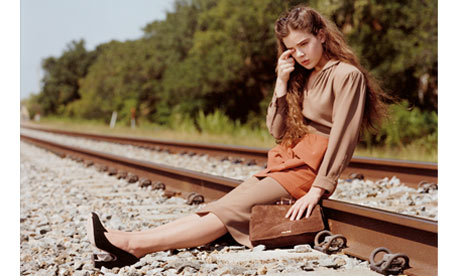
The Guardian ---> What's Happening in Fashion?!
Advertising standards have been accused many times for promoting drug use, sexual promiscuity and anorexia. They are now being hailed for this image revealed by Mui Mui. They say that it is too dangerous to promote safety on train tracks. But surely.. anyone who knows the damage a train can do should know not to sit on it anyway D:For other stories on fashion from the guardian go to http://www.facebook.com/GuardianFashion?sk=wall
Tuesday, 22 November 2011
Friday, 18 November 2011
Thursday, 17 November 2011
Sunday, 13 November 2011
Tuesday, 8 November 2011
Wednesday, 19 October 2011
Steven Fry BBC Video. "Spreading the Word."
Writing was invented about 5000 years ago. It was introduced because there were more people around and people wanted to take care of their money. The first examples of writing is all in numbers because that's all they needed at the time but eventually this erupted in to different alphabets across the world.
Reading and writing isn't classes as natural or essential, it is just something we have all picked up over the years. A tribe in North Thailand once had scriptures written on buffalo hides which were heated to keep the ink in place. Unfortunately it smelled so good, the scripts were eaten. Since said many hundred years ago, the tribe have just remebered their history and stories. The man interviewed could hold up to 53 genereations stories just in his head. He was disapointed at this because he felt it wasn't enough. He complains about the school system of writing everything down but he does see that this is a good way of preserving the tribes culture forever.
In the National British Museum, there are parts of the Bible stored away. these parts were all to do with taxing and record keeping. Actual writing began in Ancient Iraq. They began a vague alphabet but didn't realised that any form of literature would eventually formed from this. There is evidence of large blocks of clay that were imprinted on. These are classed as similar to draft books or sketch pads.
By 1200BC reading began to take off. It was around this time that the Rosetta Stone was created and this managed to translate the Ancient Egyptian Hieroglyphs.
Phenesians were the main reason that writing took off. They created a writing style and showed this to most of Europe and other parts of the world that were interested. In their point of view, the more who could read, the better as this meant that they would be able to trade together.
When this writing took off, it made religion more set in stone. Priests and Rabbis were all educated meaning that they could read, write and also remember stories well. they began writing these stories down which has helped keep them going in circles for the last 2000 years. The Wailing wall is a particularly precious and religious place for Jews. they come here to pray or to leave prayers in the wall. Some people even choose to write out the prayer and leave it in the wall. Only the Rabi is allowed to empty this wall, which occurs twice a year and gets burried in the mount of Olives. The spread of religion and the spread of reading went hand in hand. Peple became hungry for publications but for now these were only available to the rich.
A shrine in Jerusalem called The Shrine of the Book holds the so called "Dead-Sea Scrolls." These scrolls were so precious as they are said to have been hidden for 2000 years until 1946 when a Shepard stumbled across them. There are about 900 parts to this and not all is legible any more but there is a special light technology which flashes different colours of light at different velocities which is slowly helping to decode what the original text said.
The second miracle is printing. Writing was a very long winded way of recording happenings and this could take up to 3 people's life times just to finish off one book. Printing was first seen in China about 400 years before it was discovered by Johannes Gutenburg. The only reason printing didn't take off in China was because of the thousands of symbols that meant it was too difficult to grasp. The Chinese pictograms must all be drawn in a certain way otherwise it would mean something completely different.
Johannes Gutenburg realised the Chinese technique and was able to create the ever newspaper in England for Norwich.
Geoffrey Chaucer was the first person to have his literature printed out. He was very conscious of having his work printed out badly and specifically wrote to make this not happen. The printing would have pleased him.
The more and more books printed meant more demand for libraries. One man, Tita Rose began his mission to create the worlds first encyclopaedia and to have all the knowledge he could possibly get in to this book even if it was completely irrelevant.
Over the years, technology has changed the way we view books. The radio, TV, computer and eventually the internet have been invented but each time not replacing the Book. We are now living in a time of transition but so far we have proved that one medium does not kill another. if anything, since the Kindle and the iPad have been invented there have been more use for books as people don't want them to disappear. It has been proved that there are different types of reading. This calls for both the eBook and the classic book.
A lady who goes by the name "Belle D'Joux" joined the sex industry but found that talking about this to her friends would be socially unacceptable. From this she said she found it "natural" only to start up a blog to release these feelings that she often wanted to share. Over time people have been taking more and more notice of her blog and find that it is very similar to telling a story.
A new invention called the "3D virtual reality cave" is a totally amazing new way to read books. the word are now interactive and float up on a screen in front of the reader. Although this is a fantastic idea, it is obviously too expensive to achieve at the moment but maybe it will have it's time in the near future.
There is also another new invention called the "never ending reading machine." it is based like a book and even has paper to change the page with although the new technology in it is that the book is projected on to the page via an eBook system. When you are done reading the page, you can just turn the page and this interacts with the video and changes to the next slide. This is a suitable technology for all generations as all you have to do is press a button to turn it on and then turn the pages appropriately.
Another new type of technology that scientists are currently working on is a story telling movement garment. The original person wears this jackets and goes about their daily business. This is then recorded in a lab. Later on maybe thirty years down the line, an ancestor or another person can wear the same jacket but then see what a day that person went through, achieving all their movements as it would carefully guide you. This is still in the Perfection process but hopefully will be available soon.
Reading and writing isn't classes as natural or essential, it is just something we have all picked up over the years. A tribe in North Thailand once had scriptures written on buffalo hides which were heated to keep the ink in place. Unfortunately it smelled so good, the scripts were eaten. Since said many hundred years ago, the tribe have just remebered their history and stories. The man interviewed could hold up to 53 genereations stories just in his head. He was disapointed at this because he felt it wasn't enough. He complains about the school system of writing everything down but he does see that this is a good way of preserving the tribes culture forever.
In the National British Museum, there are parts of the Bible stored away. these parts were all to do with taxing and record keeping. Actual writing began in Ancient Iraq. They began a vague alphabet but didn't realised that any form of literature would eventually formed from this. There is evidence of large blocks of clay that were imprinted on. These are classed as similar to draft books or sketch pads.
By 1200BC reading began to take off. It was around this time that the Rosetta Stone was created and this managed to translate the Ancient Egyptian Hieroglyphs.
Phenesians were the main reason that writing took off. They created a writing style and showed this to most of Europe and other parts of the world that were interested. In their point of view, the more who could read, the better as this meant that they would be able to trade together.
When this writing took off, it made religion more set in stone. Priests and Rabbis were all educated meaning that they could read, write and also remember stories well. they began writing these stories down which has helped keep them going in circles for the last 2000 years. The Wailing wall is a particularly precious and religious place for Jews. they come here to pray or to leave prayers in the wall. Some people even choose to write out the prayer and leave it in the wall. Only the Rabi is allowed to empty this wall, which occurs twice a year and gets burried in the mount of Olives. The spread of religion and the spread of reading went hand in hand. Peple became hungry for publications but for now these were only available to the rich.
A shrine in Jerusalem called The Shrine of the Book holds the so called "Dead-Sea Scrolls." These scrolls were so precious as they are said to have been hidden for 2000 years until 1946 when a Shepard stumbled across them. There are about 900 parts to this and not all is legible any more but there is a special light technology which flashes different colours of light at different velocities which is slowly helping to decode what the original text said.
The second miracle is printing. Writing was a very long winded way of recording happenings and this could take up to 3 people's life times just to finish off one book. Printing was first seen in China about 400 years before it was discovered by Johannes Gutenburg. The only reason printing didn't take off in China was because of the thousands of symbols that meant it was too difficult to grasp. The Chinese pictograms must all be drawn in a certain way otherwise it would mean something completely different.
Johannes Gutenburg realised the Chinese technique and was able to create the ever newspaper in England for Norwich.
Geoffrey Chaucer was the first person to have his literature printed out. He was very conscious of having his work printed out badly and specifically wrote to make this not happen. The printing would have pleased him.
The more and more books printed meant more demand for libraries. One man, Tita Rose began his mission to create the worlds first encyclopaedia and to have all the knowledge he could possibly get in to this book even if it was completely irrelevant.
Over the years, technology has changed the way we view books. The radio, TV, computer and eventually the internet have been invented but each time not replacing the Book. We are now living in a time of transition but so far we have proved that one medium does not kill another. if anything, since the Kindle and the iPad have been invented there have been more use for books as people don't want them to disappear. It has been proved that there are different types of reading. This calls for both the eBook and the classic book.
A lady who goes by the name "Belle D'Joux" joined the sex industry but found that talking about this to her friends would be socially unacceptable. From this she said she found it "natural" only to start up a blog to release these feelings that she often wanted to share. Over time people have been taking more and more notice of her blog and find that it is very similar to telling a story.
A new invention called the "3D virtual reality cave" is a totally amazing new way to read books. the word are now interactive and float up on a screen in front of the reader. Although this is a fantastic idea, it is obviously too expensive to achieve at the moment but maybe it will have it's time in the near future.
There is also another new invention called the "never ending reading machine." it is based like a book and even has paper to change the page with although the new technology in it is that the book is projected on to the page via an eBook system. When you are done reading the page, you can just turn the page and this interacts with the video and changes to the next slide. This is a suitable technology for all generations as all you have to do is press a button to turn it on and then turn the pages appropriately.
Another new type of technology that scientists are currently working on is a story telling movement garment. The original person wears this jackets and goes about their daily business. This is then recorded in a lab. Later on maybe thirty years down the line, an ancestor or another person can wear the same jacket but then see what a day that person went through, achieving all their movements as it would carefully guide you. This is still in the Perfection process but hopefully will be available soon.
2012 Olympics logo.. What do you think?!
On the London Olympics website (http://www.london2012.com/about-us/our-brand/index.php), they talk about the way this logo was designed and what they were wanting it to look like. they say "the number 2012 has become our brand. We wanted to incorporate the olympic rings but also have a taste of London there too." This image was aiming to be the joining of people from many different countries in all different disabilities or not.
On the BBC website(http://www.bbc.co.uk/dna/606/A23431826), they have let people express what they think of the logo. They have also explained what colours the design comes in and how that will be used in the run up to the London Olympics. Some people on the page expressed dis-taste for the design- "Although i understand that designing a logo that is representational and impact provoking is very difficult, this proposed logo is very bland and unimaginative. I have designed one logo that could be used for the sailing, and i would be happy to design a few logos that maybe, in my opinion, would be more acceptable. I just hope that more imagination goes in to the opening and closing ceremonies, thanks for reading, C.J."
Most other people on the site have also taken this opinion of the logo.
On the Creative Review website, (http://www.creativereview.co.uk/cr-blog/2007/june/2012-logo-lance-wyman-says-give-it-a-chance) the writer has expressed how they thought that some previous years have been much more suitable. eg Mexico in 1968. The American designer took a font that was funky and relevant to the era and then created a whole image like this. It has been said that the new 2012 logo is "Too plain" and that it doesn't look like it represents anything other than a year.
The designer of the logo was chosen a year before the world saw the image. Wolff Olins' work has been criticized by nearly the whole world. Is it time to re-think this image?
The London Metro website let fans describe what they thought of the logo and it's choice of colours. The results they received didn't sounds as positive as most would have hoped. 'I would say I'm left speechless but it's more muttering and bashing my head against my keyboard… Fear not, should you not like pink though as it comes in a further variety of vomit inducing colours – yes, it's a pick and choose wreck of a logo.' www.diaryofawebsite.com
In my opinion, I feel that the logo is very bland compared to some others from the past, although it's bright colours look punchy and they stand out. Many people seem to be outraged by this logo after having waited a whole year to see it, it is rather disappointing and i would have hoped that the designers would have come up with something better. Maybe it is due to the small budget that is in mega over-draft to the building of the Olympic Stadium that causes cheaper designs to produce? either way.. England does seem dissapointed.
Read more: http://www.metro.co.uk/news/51740-the-london-2012-logo-the-blogosphere-is-angry#ixzz1bEtfcmdV
On the BBC website(http://www.bbc.co.uk/dna/606/A23431826), they have let people express what they think of the logo. They have also explained what colours the design comes in and how that will be used in the run up to the London Olympics. Some people on the page expressed dis-taste for the design- "Although i understand that designing a logo that is representational and impact provoking is very difficult, this proposed logo is very bland and unimaginative. I have designed one logo that could be used for the sailing, and i would be happy to design a few logos that maybe, in my opinion, would be more acceptable. I just hope that more imagination goes in to the opening and closing ceremonies, thanks for reading, C.J."
Most other people on the site have also taken this opinion of the logo.
On the Creative Review website, (http://www.creativereview.co.uk/cr-blog/2007/june/2012-logo-lance-wyman-says-give-it-a-chance) the writer has expressed how they thought that some previous years have been much more suitable. eg Mexico in 1968. The American designer took a font that was funky and relevant to the era and then created a whole image like this. It has been said that the new 2012 logo is "Too plain" and that it doesn't look like it represents anything other than a year.
The designer of the logo was chosen a year before the world saw the image. Wolff Olins' work has been criticized by nearly the whole world. Is it time to re-think this image?
The London Metro website let fans describe what they thought of the logo and it's choice of colours. The results they received didn't sounds as positive as most would have hoped. 'I would say I'm left speechless but it's more muttering and bashing my head against my keyboard… Fear not, should you not like pink though as it comes in a further variety of vomit inducing colours – yes, it's a pick and choose wreck of a logo.' www.diaryofawebsite.com
In my opinion, I feel that the logo is very bland compared to some others from the past, although it's bright colours look punchy and they stand out. Many people seem to be outraged by this logo after having waited a whole year to see it, it is rather disappointing and i would have hoped that the designers would have come up with something better. Maybe it is due to the small budget that is in mega over-draft to the building of the Olympic Stadium that causes cheaper designs to produce? either way.. England does seem dissapointed.
Read more: http://www.metro.co.uk/news/51740-the-london-2012-logo-the-blogosphere-is-angry#ixzz1bEtfcmdV
Response to Vivienne Westwood reading.
Author: Blanchard, T
Extract title: Vivienne Westwood.
Book or Journal Title: Fashion and Graphics.
Pages: 62-67
In this section of the book, the company of Vivienne Westwood is described. It shows how cleverly she has set up the business and how the logos are now so well recognised that they are practically her signature now.
Over the different ranges you can see how each of them reflect her flamboyant personality but still use the original themes of delicate and pink with gold royalty. Each different section of her label has its own character with represents the sector. These are good as they show the lifestyle and personality of what the typical person who would be interested in wearing the brand, should be like. Red Label looks very chic and ladylike, whilst the MAN label takes a more caveman and natural feel.
Extract title: Vivienne Westwood.
Book or Journal Title: Fashion and Graphics.
Pages: 62-67
In this section of the book, the company of Vivienne Westwood is described. It shows how cleverly she has set up the business and how the logos are now so well recognised that they are practically her signature now.
Over the different ranges you can see how each of them reflect her flamboyant personality but still use the original themes of delicate and pink with gold royalty. Each different section of her label has its own character with represents the sector. These are good as they show the lifestyle and personality of what the typical person who would be interested in wearing the brand, should be like. Red Label looks very chic and ladylike, whilst the MAN label takes a more caveman and natural feel.
Sunday, 16 October 2011
Response to Lecture 12.10.2011
My 4 favourite photographs from this lecture is,
1: Harold Edgarton's Drop of milk splashing in to a saucer of milk because of the way it has been captured so perfectly.
2: Christopher Kane on the catwalk, because he has taken something that has become so taboo in fashion and made it more acceptable. This brings forward a notice that not every one has to look like Twiggy!
3: Santiago Sierra because his idea seemed so outrageous and obscene and why would any one do that, but in the end it proves a very valid point. The way he has taken this to show that you can buy a person no matter what their race of financial situation shows just how much of a commercial age we are in.
4: Finally, the idea of photographic Manipulation. The Picture of Stalin's wingman being completely erased from history is a little scary. I have been fascinated by this idea as it is very similar to a book I studied at A Level- 1984 by George Orwell. This makes it seem like his predictions were more like a premonition.
Sunday, 9 October 2011
Lecture notes and task response from 05.10.2011.
In this lecture we looked at the importance of photography and how it can be used in most situations. The presentation showed how there are many issues to do with photography that can show the fine lines between how risky subjects are. We have looked at different styles of photography and how it has changed over the years. The task set was to read the press release on Blackboard and to look at the interview with Sally Mann. The interview was good because it showed Sally's personal views on photography and why she is so interested in doing this as an occupation. She doesn't seem scared what people will think of her work as she has found it interesting enough to turn it in to art work and she isn't copying any one else's work or styles. With regards to the pictures of her children, she claims, "I am just a mother taking pictures of my children doing things that children do." the response to the press release is in the pictures above.
Responses to Lecture 28.09.2011.
In this lecture we looked at "What is Creative Practises?" and what does it involve. We looked deeper in to each section which was- Visual Culture, Fashion, Graphics and Photography. We have discusses what we will all be looking at over the next year and in to what detail we shall be studying each part of creative practises and the history of each part.
Evidence of Creative Practises! -Graphics, Photography and Fashion.
- Vaseline Tub shows Graphics and also in a way fashion. The tub is fashioned in to a way that makes females want to buy it. Vaseline have also used colours that women find appealing too!
- This DVD case shows all 3 creative practises. Photography of the actresses' on the cover, Fashion frpm the clothes they are wearing and Graphics from the back ground and writing on the cover.
Tuesday, 4 October 2011
Monday, 3 October 2011
Inspiring Video
DECO Vintage fashion Lookbook 2011 by Abz36
I found this video on youtube and I found it instantly really interesting.
It's a fun way to create a fashion blog video but also gets the new season
fashion across easily and in a fun way!
I found this video on youtube and I found it instantly really interesting.
It's a fun way to create a fashion blog video but also gets the new season
fashion across easily and in a fun way!
Friday, 30 September 2011
A Picture is Worth A Thousand Words.-. Donna Meyres.
These pictures represent me because I have a very colourful personality.
Plus I am also that annoying person at every event with a camera!
I have found these pictures particularly inspiring as the top image is
a heart made from photos and the bottom one because I would be interested to see if this would actually work!
Subscribe to:
Comments (Atom)